Creating a workspace is more than setting up a desk – it’s about nurturing the mindset and calm that inspires focus and creativity. Learn how to create one that’s perfect for you.
Whether you work from home or need a dedicated space to focus on journalling, studying, a personal project, or side hustle, it can be hugely beneficial to make this area – however small – a place conducive to concentration and creative thinking. Perching on the edge of the sofa with paperwork spread over a coffee table or hunching over a laptop at the kitchen table isn’t necessarily the best thing for your body – or your mind. In recent years, there has been an increase in hybrid and remote working, higher levels of self-employment, and people keen to work on their own creative projects from home. Many begin with a makeshift arrangement, perhaps sharing their workspace with other members of the household or having a dual-purpose room but, as time goes on, it makes sense to make your homeworking environment as ergonomically sound, comfortable, and good for your wellbeing as possible.
Light, scent, & atmosphere
Rebecca Seal is a self-employed writer and author of Solo: How to Work Alone (and Not Lose Your Mind).
She also has a podcast, The Solo Collective, aimed at supporting solitary workers. She says that, regardless of whether you’re working from home full-time, part-time, as a side hustle, or on a personal or study project, it’s vital to create mental boundaries between your work area and living space: ‘You might only have a small space, or it might be a place that doubles up as a workspace and family space, but there are things you can do to signal the difference between work time and personal time. Try putting all of your work things in a box when you’ve finished and hiding the box behind the lounge. Or drape a sheet over your desk as a symbolic gesture that your working day is done.’
She also suggests thinking about the way your workspace is lit, using a combination of overhead lighting, floor lamps, and desk lamps to mimic what’s going on with the natural light outside, and making sure you work in softer lighting as dusk falls, so you don’t affect your natural sleep cycle.
In addition, taking time to create an environment that’s conducive to creativity gives a useful signal to your brain. ‘You might have a specific candle or essential oils you like to burn when you sit down to a certain task,’ says Rebecca. ‘Or a corkboard that you set up behind your computer with pictures, postcards, and textures that inspire you.
Create rituals that signal work time

Just taking a couple of minutes to get yourself settled with a cup of herbal tea, a plant somewhere in your eyeline, a candle, and your favourite cushion before you open your laptop sends a signal to your brain that this work is important and worth carving out space for.’ It can also double up as a sign to other members of your household that you don’t want to be interrupted.
Rebecca talks about the importance of carving out regular breaks for yourself and following the 20/20/20 rule of taking a breather of at least 20 seconds every 20 minutes and moving your gaze away from your screen to look at something at least 20 metres away – which is why setting up your desk or workspace near a window can be useful. If you can step outside into a garden or even just stand at a door to take a few breaths of fresh air, you’re likely to feel even more benefits: ‘Getting outside is one of the most profound things you can do to improve your ability to get things done inside.’
Build boundaries between work and home
If it’s possible to separate your living space from your work area in a more physical way, even better. Turning a spare room into an office, so you can close the door on your work when you’re done, is a great idea if you have the space. Kerri McCrossan is a mortgage advisor and runs her own business from home. She built a home studio to create a greater separation between her working life and home life. ‘I love my office, as it’s like my little sanctuary,’ she says. ‘Having it separate to the house means there is that distinction between the home and the office, but I also use it as a space for myself – sometimes, I come out in the evening to do a meditation class as it’s private and I won’t be disturbed.’ Kerri has taken steps to make her studio as comfortable as possible, explaining: ‘I have some candles and a lamp so I can have softer lighting in the evening. I’ve added lots of greenery to my garden so I can look out of the window, and I keep all my thank-you cards from clients on a string on the wall.’
Care for your body & mind with ergonomics
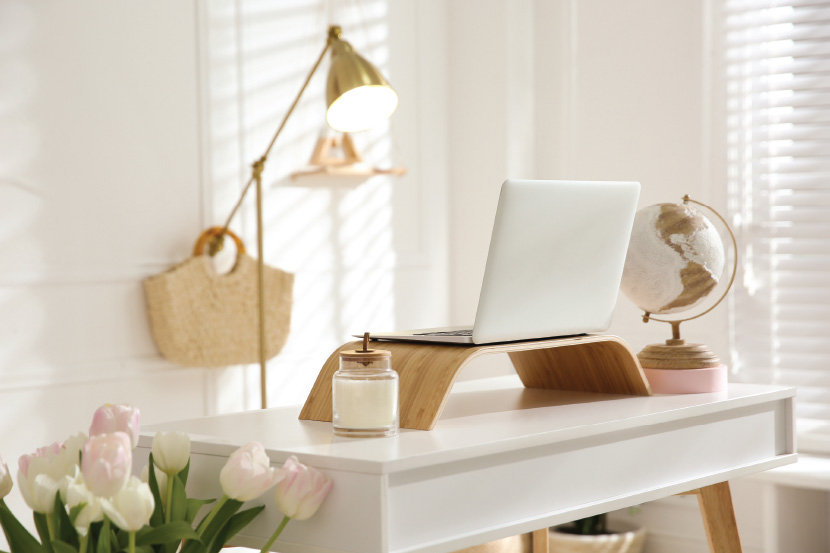
Working environments shouldn’t be detrimental to wellbeing, and your home workspace is no exception. If you’re sitting at a desk and typing at a keyboard, you may need a footrest and wrist supports. Doing something physical in a home workshop might require a visor or hearing protection. And if you’re spending a lot of time sitting down, it could be worth investing in a standing desk, or cheaply creating a standing workstation with a shelf at an appropriate height for your laptop.
Johnny Cassidy, a physiotherapist and clinical director, says it’s vital to consider ergonomics to protect your back and neck. He adds that incorporating as much movement as you can into your working life is the number one thing you can do: ‘Sit-to-stand desks are good, and the key is making sure you’re alternating between the two regularly,’ he says. ‘You can also do less computer-heavy tasks standing, such as phone calls, and set your laptop on a shelf so you can see it. I’m a massive fan of exercise balls, too. They’re cheap and cheerful, and you have to have an active posture when you’re on an exercise ball, otherwise you’ll fall off.’
Johnny’s special interest lies in treating neck pain, headaches, and dizziness, and he suggests a lot of health issues are caused by people looking down at screens – or “text neck”. He adds: ‘Ideally your ears should fall in line with your collar bones. Cervical traction exercises (which lightly pull the head away from the neck to create space between the bones in your neck) can be helpful.’
Movement as a daily essential
Arguably one of the best things about working from home is that it gives you an opportunity to rethink what a traditional working day looks like. You might consider breaking it up to allow for an exercise class, run, or dog walk in the middle of the day. You could even replace video conference calls with walking meetings in a park if colleagues or clients live in close proximity.
At the very least, you could move around your workspace, stand to take phone calls, and experiment with what Johnny calls ‘a more active sitting position’. He adds: ‘Even if you get up to grab a glass of water from the kitchen regularly, it gets you moving. Ask yourself if your working day can look different.’